A value chain refers to the business activities and processes involved in creating a product or delivering a service. It consists of the different steps required to provide value to customers, such as research, development, sales, and delivery.
The concept was introduced by Michael Porter in his 1985 book, Competitive Advantage: Creating and Sustaining Superior Performance.
A value chain is divided into two categories:
Support Activities – Activities that support and improve primary activities.
Primary Activities – Activities directly involved in creating and delivering a product or service.
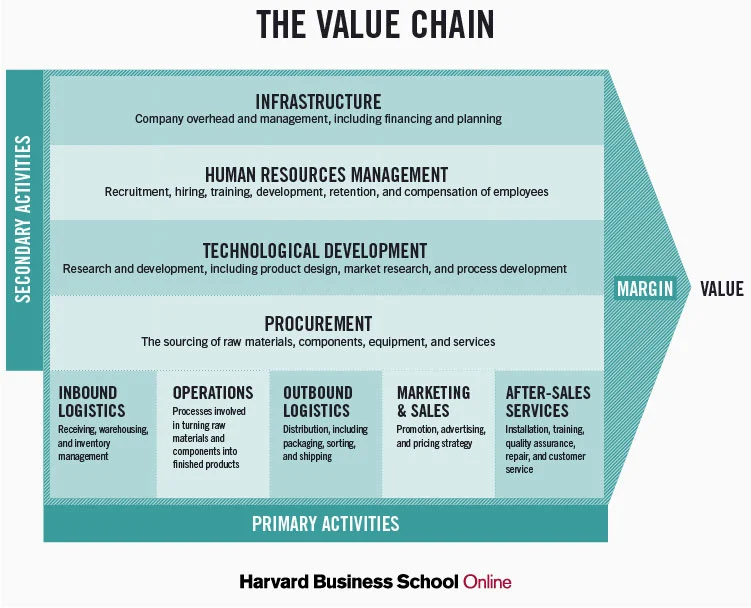
Primary Activities
Primary activities are directly involved in creating a product or delivering a service:
- Inbound Logistics: Receiving, storing, and managing raw materials and components.
- Operations: Converting raw materials into finished products.
- Outbound Logistics: Packaging, sorting, and distributing products to customers.
- Marketing and Sales: Promoting, advertising, pricing, and selling products or services.
- After-Sales Service: Installation, training, maintenance, repairs, and customer support.
Support Activities
Support activities help primary activities operate more efficiently and create a competitive advantage:
- Procurement: Sourcing raw materials, equipment, and services.
- Technology Development: Research and development, product design, and process improvement.
- Human Resource Management: Recruiting, training, developing, and retaining employees.
- Infrastructure: Company management, finance, planning, and administrative functions.
Value Chain Analysis
In simple terms, value chain analysis is the process of examining each activity involved in creating a product or delivering a service. Businesses analyze every step in the value chain to understand how it contributes to both cost and customer value. The objective is to identify opportunities to make activities more efficient, reduce unnecessary expenses, and improve overall performance. It can also help businesses determine where additional investment in time, resources, or innovation could make a product or service stand out from competitors. By optimizing these activities, organizations can either lower costs, increase customer satisfaction, or gain a competitive advantage.
Importance Of Value Chain Analysis
Value chain analysis is an important tool for optimizing business operations. It helps businesses identify opportunities to reduce costs, improve efficiency, and create greater value for customers. By providing a clear overview of how different activities contribute to the final product or service, it supports better strategic decision-making, improves customer satisfaction, encourages innovation, and helps organizations address environmental and social impacts.
Steps to conduct value chain alaysis
1. Identify Value Chain Activities
Begin by identifying all primary and support activities involved in creating and delivering your product or service. If your business offers multiple products or services, conduct a separate value chain analysis for each one.
2. Determine Activities’ Value and Costs
After identifying the activities, evaluate the value each one adds and the costs associated with it. Consider how the activity contributes to customer satisfaction, creates value for the business, and whether it can be improved through innovation, better materials, new technologies, or more efficient processes. This analysis helps uncover opportunities to improve performance, reduce expenses, and enhance the overall customer experience.
Identify Competitive Advantage
Once the value chain has been mapped and evaluated, analyze it based on your objective. If the goal is cost reduction, look for activities that can be streamlined, automated, outsourced, or eliminated to improve efficiency. If the goal is differentiation, focus on activities that create the most value for customers and determine whether additional investment could make the product or service more unique.
A value chain analysis often reveals many improvement opportunities. Businesses should prioritize initiatives that require the least effort while delivering the greatest return on investment, allowing them to achieve meaningful results and build a sustainable competitive advantage.